
Kyoto
Kyoto was Japan's imperial capital for more than a thousand years. Its temples, shrines, gardens and old wooden streets make it the country's most rewarding city to walk.
 (opens the tour on Viator in a new tab)
The city on foot
Kyoto holds more than a thousand temples and hundreds of shrines, and seventeen of its historic sites together form a UNESCO World Heritage Site. Its old districts, especially Gion and Higashiyama, keep their wooden townhouses and stone-paved lanes, and geiko and maiko still work in its teahouses.
The city is laid out on a grid in a basin ringed by wooded hills, and many of the best walks run along the foot of those hills. The flat centre is easy but spread out, so most people pick one district at a time and use a train or bus to get between them.
The eastern side is the natural place to begin: Kiyomizu-dera, down the stone slopes to Gion, and then north towards the Philosopher's Path. The most famous places are very crowded, so go early or try the quieter northern and western districts.
Tip-based walks are listed for Gion and Higashiyama, typically about two and a half hours. A paid guide is more useful in Gion than most places, since much of the interest is cultural and some lanes are off limits. Self-guided walks work well on the Philosopher's Path and at Fushimi Inari, which is open all night and has no entrance fee.
What makes Kyoto distinctive
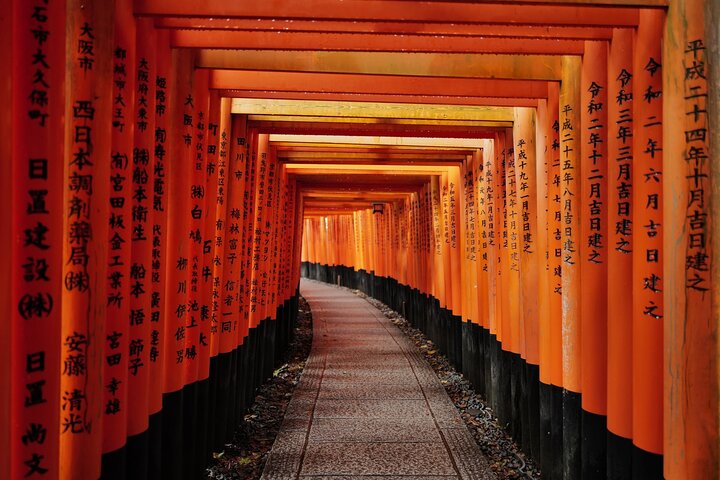
- The torii gate tunnels of Fushimi Inari
- Gion and Higashiyama, the old wooden districts
- The bamboo grove and temples of Arashiyama
- Zen gardens and the Golden Pavilion
Walking tours in Kyoto
Hand-picked guided walks in Kyoto, each rated highly by travellers. Ratings and photos are from Viator; select a tour to see dates, prices and full details, and to book.
Advertising disclosure: tour links go to Viator. If you book through one, we may earn a commission at no extra cost to you. It does not affect the price you pay or which tours we choose.
Kyoto: Gion Hidden Gems & Geisha Culture Tour (opens Viator in a new tab)
A two-hour walk through Gion's quiet lanes, Edo-period townhouses and an ancient shrine, with a chance to spot a geiko or maiko. Tour details: Kyoto: Gion Hidden Gems & Geisha Culture Tour
Guided in English
From £15Free cancellation
See dates & bookBooked securely on Viator
Fushimi Inari Hidden Hiking Tour (Private Option Available) (opens Viator in a new tab)
A guided hike up the quieter trails of Fushimi Inari, away from the crowds at the bottom of the torii gate tunnels. Tour details: Fushimi Inari Hidden Hiking Tour (Private Option Available)
Guided in English
From £37Free cancellation
See dates & bookBooked securely on Viator
Kyoto Arashiyama Walking Tour: Bamboo, Monkeys, Garden & Secrets (opens Viator in a new tab)
A small-group walk through Arashiyama: the bamboo grove, Tenryu-ji garden, Togetsukyo Bridge and the monkey park's views over Kyoto. Tour details: Kyoto Arashiyama Walking Tour: Bamboo, Monkeys, Garden & Secrets
Guided in English
From £46Free cancellation
See dates & bookBooked securely on Viator
Kyoto Ghost Tour: Dark Tales, Urban Legends, Bamboo Forest Night (opens Viator in a new tab)
An evening walk with Kyoto's ghost stories and urban legends, ending in the bamboo forest after dark. Tour details: Kyoto Ghost Tour: Dark Tales, Urban Legends, Bamboo Forest Night
Guided in English
From £32Free cancellation
See dates & bookBooked securely on Viator
Kyoto Early Morning Tour with English Speaking Guide (opens Viator in a new tab)
An early start to beat the crowds at Fushimi Inari, Kinkaku-ji and Arashiyama, with an English-speaking guide. Tour details: Kyoto Early Morning Tour with English Speaking Guide
Guided in English
From £76Free cancellation
See dates & bookBooked securely on Viator
3-Hour Kyoto Insider Sake Brewery Tour with Tastings & Pairings (opens Viator in a new tab)
A sake specialist explains how sake is made and how to choose it, with tastings and food pairings. Tour details: 3-Hour Kyoto Insider Sake Brewery Tour with Tastings & Pairings
Guided in English
From £65
See dates & bookBooked securely on Viator
Nishiki Market Brunch Walking Tour (7 Tastings + Brunch) (opens Viator in a new tab)
A morning walk through Gion to Nishiki Market, with seven tastings and brunch. Tour details: Nishiki Market Brunch Walking Tour (7 Tastings + Brunch)
Guided in English
From £55Free cancellation
See dates & bookBooked securely on Viator
Kyoto Fushimi-Inari Night Walking Tour (opens Viator in a new tab)
Fushimi Inari's lantern-lit gates in the evening, cooler and far quieter than by day. Tour details: Kyoto Fushimi-Inari Night Walking Tour
Guided in English
From £32Free cancellation
See dates & bookBooked securely on Viator
Kyoto Gion Geisha District Walking Tour - The Stories of Geisha (opens Viator in a new tab)
A walk through Gion, Kyoto's geisha district, and the stories behind it. Tour details: Kyoto Gion Geisha District Walking Tour - The Stories of Geisha
Guided in English
From £23Free cancellation
See dates & bookBooked securely on Viator
Kyoto: Arashiyama Bamboo Forest, Monkey Park & Temple Tour (opens Viator in a new tab)
A walk through Arashiyama's bamboo forest, temple and monkey park. Tour details: Kyoto: Arashiyama Bamboo Forest, Monkey Park & Temple Tour
Guided in English
From £44Free cancellation
See dates & bookBooked securely on Viator
Kyoto Gion Backstreets and Geisha Traditions Tour (opens Viator in a new tab)
A walk through Gion's backstreets and its geisha traditions. Tour details: Kyoto Gion Backstreets and Geisha Traditions Tour
Guided in English
From £24Free cancellation
See dates & bookBooked securely on Viator
Kyoto: Gion Food Tour 13 Dishes at 4 Eateries (opens Viator in a new tab)
A food walk through Gion with thirteen dishes at four eateries. Tour details: Kyoto: Gion Food Tour 13 Dishes at 4 Eateries
Guided in English
From £63Free cancellation
See dates & bookBooked securely on Viator
Kyoto Sake Tour in Fushimi: 18 Sake Tastings & Historic Breweries (opens Viator in a new tab)
A walk through Fushimi's historic sake breweries with tastings. Tour details: Kyoto Sake Tour in Fushimi: 18 Sake Tastings & Historic Breweries
Guided in English, Japanese
From £69Free cancellation
See dates & bookBooked securely on Viator
Kyoto Foodie Night Tour (opens Viator in a new tab)
An evening food walk from Nishiki Market to Pontocho with seven or more tastings and three drinks, enough for dinner. Tour details: Kyoto Foodie Night Tour
Guided in English, Japanese
From £90
See dates & bookBooked securely on Viator
5-hr Kyoto Arashiyama Bamboo forest & Hidden Garden Walking Tour (opens Viator in a new tab)
A five-hour walk through Arashiyama, from Tenryu-ji and the bamboo grove to Okochi Sanso Garden and the Togetsukyo Bridge. Tour details: 5-hr Kyoto Arashiyama Bamboo forest & Hidden Garden Walking Tour
Guided in English
See dates & bookBooked securely on Viator
Kyoto Early Bird Walking Tour (opens Viator in a new tab)
An early start at Fushimi Inari, Kinkakuji and Arashiyama, linked by train, to see them before the crowds. Tour details: Kyoto Early Bird Walking Tour
Guided in English
See dates & bookBooked securely on Viator
Kyoto Meet the Geisha Maiko with Gion Walking Tour (opens Viator in a new tab)
A walk through Gion Shirakawa and Hanamikoji Street on the geisha districts, finishing with a meeting with a maiko. Tour details: Kyoto Meet the Geisha Maiko with Gion Walking Tour
Guided in English
See dates & bookBooked securely on Viator
Kyoto Gion Night Walk & Geisha District Guided Tour (opens Viator in a new tab)
An evening walk through Gion, from Hanamikoji Street past Yasui Konpiragu and Nene-no-Michi to Maruyama Park and the Yasaka Shrine. Tour details: Kyoto Gion Night Walk & Geisha District Guided Tour
Guided in English, French, Spanish
See dates & bookBooked securely on Viator
Kyoto Nishiki Market Food & Culture Tour with Izakaya Lunch (opens Viator in a new tab)
A small-group walk through the Nishiki market and Teramachi, tasting street food, with an izakaya lunch. Tour details: Kyoto Nishiki Market Food & Culture Tour with Izakaya Lunch
Guided in English
See dates & bookBooked securely on Viator
Kyoto Gion & Higashiyama Historical Walking Tour (opens Viator in a new tab)
A walk through Gion and Higashiyama, from the Tatsumi Bridge and Chion-in to Maruyama Park, Nene-no-Michi and Kiyomizu-dera. Tour details: Kyoto Gion & Higashiyama Historical Walking Tour
Guided in English
See dates & bookBooked securely on Viator
Kyoto: Gion & Pontocho Food Tour with 13 Dishes (opens Viator in a new tab)
A small-group evening food walk through Gion and Pontocho with thirteen dishes and stories of geisha culture. Tour details: Kyoto: Gion & Pontocho Food Tour with 13 Dishes
Guided in English
See dates & bookBooked securely on Viator







Prices are Viator's lowest "from" price per person, converted to pounds and checked on 29 October 2026. The booking page shows the current price in your currency.
By theme: Food tours in Kyoto · History walks in Kyoto · Night and ghost tours in Kyoto
Compare with other cities: Food tours · History walks · Night and ghost tours
More walking tours on GetYourGuide
GetYourGuide sells many of the same walks and some that Viator doesn't. Their list for Kyoto is chosen and ranked by GetYourGuide, not by us.
Search Kyoto on GetYourGuide (opens in a new tab)
The button loads content from GetYourGuide, which may set cookies. Links are affiliate links: we may earn a commission if you book.
Main sights
- Fushimi Inari Taisha
About 10,000 torii gates, including the roughly 800 of the Senbon Torii. Trails of about 4 km cover the 233 m mountain, and the climb takes about two hours. The shrine is open 24 hours with no entrance fee. Crowds thin quickly above the first section.
Tickets and tours on GetYourGuide for Fushimi Inari Taisha (opens in a new tab) - Kiyomizu-dera
A hillside temple in the foothills of Mount Otowa, traditionally founded in 778. The main hall's great wooden stage juts out over the slope on tall pillars. Below it, three channels of the Otowa waterfall run into a pond.
Tickets and tours on GetYourGuide for Kiyomizu-dera (opens in a new tab) - Kinkaku-ji
The Golden Pavilion, reflected in its pond, in the north of the city. It is listed as open from 09:00 to 17:00. Early arrival gives you the best chance of space by the water.
Tickets and tours on GetYourGuide for Kinkaku-ji (opens in a new tab) - Arashiyama bamboo grove
A path through towering bamboo near Tenryu-ji, whose Sogenchi pond garden is worth the detour. Go at dawn. The Togetsukyo bridge, rebuilt in 1934, spans the river close by.
Tickets and tours on GetYourGuide for Arashiyama bamboo grove (opens in a new tab) - Philosopher's Path
A canal-side path about 2 km long, beside a channel of the Lake Biwa canal system, lined with cherry trees. It is named after the philosopher Nishida Kitaro, who is said to have walked here.
Tickets and tours on GetYourGuide for Philosopher's Path (opens in a new tab) - Yasaka Shrine and Gion
Where the Higashiyama walk meets Gion. Hanamikoji is the public main street, but private lanes around it carry a ¥10,000 fine for entering.
Tickets and tours on GetYourGuide for Yasaka Shrine and Gion (opens in a new tab)
Ticket links are affiliate links: if you book through one, we may earn a commission at no extra cost to you.
Neighbourhoods worth wandering
- Gion
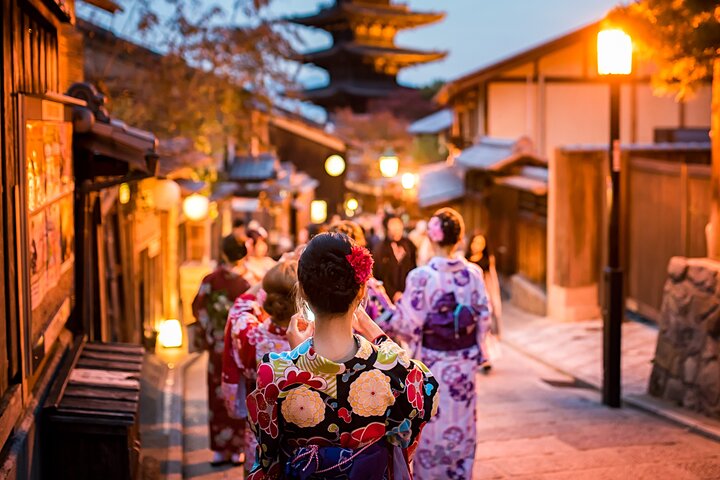
The geiko district, with teahouses and the Shirakawa canal. Since 2024, signs on private roads have warned visitors of a ¥10,000 fine. Hanamikoji remains open, so stick to the public streets and leave the alleys alone.
- Higashiyama
Stone-paved slopes leading up to Kiyomizu-dera. Sannenzaka and Ninenzaka are protected historic streets, and Sannenzaka is the steeper of the two. Local superstition warns that a fall here shortens your life, which is at least a reason to watch your step.
- Arashiyama
Western Kyoto's river, bamboo and temples, with Iwatayama Monkey Park on the slopes across the water. The river is known as the Oi upstream and the Katsura lower down.
- Central Kyoto
Nishiki Market, the Teramachi arcades and the Kamo river. Flat and easy on foot, with covered streets for wet days.
Higashiyama, from Kiyomizu-dera down to Gion
A free self-guided walk from Kiyomizu-dera down the stone lanes of Sannenzaka and Ninenzaka, past the Yasaka Pagoda and Kodai-ji, through Maruyama Park to Yasaka Shrine and Gion.
See the walkBest areas to explore on foot
- Higashiyama walk
From Kiyomizu-dera down Sannenzaka and Ninenzaka to Yasaka Shrine and Gion. Starting at the top keeps you going downhill. Expect stone paving and steps, and crowds from mid-morning.
- Philosopher's Path
From Ginkaku-ji south to the Nanzen-ji area, about 2 km and 30 to 40 minutes with no stops. It is fairly flat. In cherry blossom season, start early.
- Kamo river
Riverside paths through the city centre, popular in the evening, with restaurants busy at dusk. Blossom lines the banks in spring. The Keihan Line runs alongside, which is useful for a one-way walk.
- Fushimi Inari circuit
The whole mountain takes about two hours, so turn back whenever you have had enough. Trails are stepped and shaded, and the crowds are heaviest near the bottom.
- Arashiyama
A short walk links Togetsukyo, Tenryu-ji and the bamboo grove. Go at dawn for the grove.
Practical walking notes
- Terrain
A flat grid in the centre; hills, steps and stone slopes in the eastern and northern temple districts.
- Crowds
Start early. Famous sites are much quieter before 08:00, and Fushimi Inari has no closing time, so it can be walked at any hour.
- Etiquette
Do not photograph geiko or maiko without permission, and stay out of private lanes in Gion, where signs warn of a ¥10,000 fine.
- Rain and heat
The rainy season runs from about mid-June to the end of July and typhoons from late August into September. Summers are humid, so walk early and carry water. Wet stone paving and shrine steps need care.
- Hills and stairs
Temples on the eastern and northern hills involve climbs and many steps. Fushimi Inari has many steps on the way up. Higashiyama's slopes are easier taken downhill.
- Distances
Districts are spread out, so plan one area on foot at a time. The Philosopher's Path and the Higashiyama walk can be joined up on a long day, but neither Arashiyama nor Fushimi Inari is a walk from the centre.
When to visit
- Spring
Cherry blossom season, beautiful and very crowded.
- Summer
Hot and humid; the Gion Matsuri festival fills July.
- Autumn
Spectacular autumn leaves in November; also very busy.
- Winter
Cold and quiet, sometimes with snow on the temples.
Getting there and getting around
Arriving
- By rail
The Shinkansen reaches Kyoto from Tokyo in a little over two hours. Osaka is 15 minutes by Shinkansen or about 30 by local train.
- By air
Kansai International Airport is about 75 minutes away by the Haruka express.
Local transport
- Buses
Buses reach most temples but are often crowded; trains and the subway are faster where available.
- On foot
The eastern temple districts are best explored walking.
Questions travellers ask about Kyoto
Are there free walking tours in Kyoto?
Yes. Tip-based walks are listed for Gion and Higashiyama, typically about two and a half hours, often starting near Gion-Shijo station. You pay what you think fair at the end. Booking is usually free, but check the current schedule.
Should I take a free tour, a paid tour or walk alone in Kyoto?
A tip-based walk is a sensible introduction to Gion. A paid guide is worth it for geiko culture and the etiquette of the area. Self-guided routes suit the Philosopher's Path, Higashiyama and Fushimi Inari.
How walkable is Kyoto?
Each district is very walkable, but the city as a whole is too spread out to cross on foot in a day. Combine walking with trains, the subway and buses, and choose one area at a time.
How long does the Philosopher's Path take?
About 30 to 40 minutes to walk the 2 km without stopping. It takes longer if you visit Ginkaku-ji or Nanzen-ji at either end.
How long does it take to walk Fushimi Inari?
About two hours to walk up and around the 233 m mountain on trails of about 4 km. You can turn back at any point.
How many days do I need in Kyoto?
Three days cover the main districts; more time lets you enjoy quieter temples and gardens.
How do I see Fushimi Inari without crowds?
Go very early or in the evening, and climb beyond the first gates; crowds thin quickly further up the mountain.
Can I see a geiko?
You may glimpse geiko or maiko in Gion in the early evening. Please be respectful, and never block their way or photograph them without permission.
Other cities in Japan

Tokyo
A megacity of quiet lanes, shrines and neon, safe to walk at any hour
Discover the city
Osaka
Japan's kitchen: neon, street food and a famous castle
Discover the city
Kanazawa
Gardens, geisha streets and samurai houses
Discover the city
Hiroshima
A city of peace
Discover the city
Nara
Temples and tame deer
Discover the city
Kobe
A port city of sake and beef
Discover the city
Takayama
An Edo-period merchant town in the Alps
Discover the city
Kamakura
Temples, shrines and the Great Buddha
Discover the cityJapan
Safe, orderly streets where every neighbourhood feels different
Explore destinationsSources and review date
- Kyoto, Wikipedia (accessed 2026-10-26)
- Historic Monuments of Ancient Kyoto (Kyoto, Uji and Otsu Cities), UNESCO World Heritage List (accessed 2026-10-26)
- Kyoto, Wikivoyage (accessed 2026-11-09)
- Fushimi Inari-taisha, Wikipedia (accessed 2026-11-09)
- Fushimi Inari Taisha official site (accessed 2026-11-09)
- Kiyomizu-dera, Wikipedia (accessed 2026-11-09)
- Philosopher's Walk, Wikipedia (accessed 2026-11-09)
- Philosopher's Path, japan-guide.com (accessed 2026-11-09)
- Arashiyama, Wikipedia (accessed 2026-11-09)
- Sannenzaka, Wikipedia (accessed 2026-11-09)
- Kyoto to limit tourist access in the historical Gion geisha district, Time Out (accessed 2026-11-09)
- Free walking tours in Kyoto, GuruWalk listings (accessed 2026-11-09)